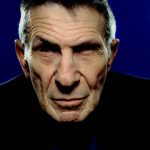
At the age of 83, Leonard Nimoy tweeted his last, telling followers to ‘live long and prosper’, his character’s catchphrase from the sci-fi series Star Trek. Just five days later he passed away in his Bel Air home having been admitted to hospital with chest pains the previous week.
Nimoy had announced a year earlier that he was suffering from chronic obstructive pulmonary disease (COPD). The progressive lung disease narrows the airways, making it increasingly difficult to breathe and is primarily caused by smoking. “I quit smoking 30 years ago. Not soon enough. I have COPD. Grandpa says, quit now!! LLAP,” Nimoy tweeted in January 2014.
The cult TV star began his career in his early twenties, teaching acting classes in Hollywood and receiving only small parts in low-quality movies throughout the 1950s, along with a minor TV role.
He served in the Army for two years, rising to sergeant and spending 18 months at Fort McPherson in Georgia, where he presided over shows for the Army’s Special Services branch before receiving his final discharge in November 1955.
Following his stint in the military, he returned to California, continuing his acting career. To support a wife and two children he often did other work, such as delivering newspapers, working in a pet shop, as a movie usher, and driving cabs.
In 1965, he made his break, making his first appearance in the rejected Star Trek pilot “The Cage”, and went on to play the character of Spock until 1969, followed by eight feature films and guest slots in the various spin-off series. The character has had a significant cultural impact and garnered Nimoy three Emmy Award nominations; TV Guide named Spock one of the 50 greatest TV characters.
Nimoy himself created the Vulcan salute, one of the most recognised and unique symbols in television and movies. The actor was inspired from childhood memories of the way kohanim (Jewish priests) hold their hand when giving blessings.
He also came up with the concept of the “Vulcan Nerve Pinch,” which he suggested as a replacement for the scripted knock out method of using the butt of his phaser. He wanted a more sophisticated way of rendering a person unconscious. Nimoy explained to the show’s director that Spock had, per the story, gone to the Vulcan Institute of Technology and had studied human anatomy.
Nimoy’s fame as Spock was such that both of his autobiographies, I Am Not Spock (1975) and I Am Spock (1995), were written from the viewpoint of sharing his existence with the character.
The actor said that the character of Spock, which he played twelve to fourteen hours a day, five days a week, influenced his personality in private life. Each weekend during the original run of the series, he would be in character throughout Saturday and into Sunday, behaving more like Spock than himself—more logical, more rational, more thoughtful, less emotional and finding a calm in every situation. It was only on Sunday in the early afternoon that Spock’s influence on his behaviour would fade off and he would feel more himself again—only to start the cycle over again on Monday morning.
“To this day, I sense Vulcan speech patterns, Vulcan social attitudes and even Vulcan patterns of logic and emotional suppression in my behavior,” the actor wrote years after the original series ended.
As well as Spock, Nimoy also turned his hand to directing, heading up two of the Star Trek movies as well as the award winning Three Men and a Baby.
His artistic pursuits also included photography, exhibiting his work at various galleries and museums and publishing several books; music, releasing five albums of sci-fi music and traditional folk songs, and poetry.
It was the last of these skills that helped him form his last message to the world.